📌 Key Takeaways:
- ChatGPT holds 60.4% of the AI chatbot market as of March 2026, but Claude’s quarterly growth of 14.2% versus ChatGPT’s 4.1% signals a concrete competitive shift.
- Google Gemini’s free tier now includes image generation, voice chat, and Gmail/Drive integration — features that cost money on competing platforms.
- DeepSeek offers its full DeepThink reasoning mode completely free with no artificial usage caps, making it the strongest zero-cost option for developers and technical users.
Introduction
ChatGPT’s grip on the AI market is loosening at a measurable pace. The free tier of OpenAI’s flagship product now competes directly against alternatives that were paid-only eighteen months ago — and in several critical benchmarks, the alternatives win. Claude Sonnet 4.6 outperforms GPT-5.2 on structured long-document comprehension. Gemini 2.5 Flash scores higher than GPT-3.5 on most standard benchmarks while remaining entirely free. Perplexity cites every source in real time, a fundamental capability the free tier of ChatGPT still lacks.
For developers, researchers, writers, and everyday users tired of hitting rate limits or questioning whether a $20 monthly subscription is justified, the 2026 free-tier landscape offers genuine alternatives — not compromises. This article evaluates the six most capable free ChatGPT alternatives based on verified feature data, current pricing structures, and real benchmark comparisons. The goal is not to find a single winner but to map which tool performs best for which specific workload.
Why Users Are Leaving ChatGPT’s Free Tier in 2026
ChatGPT’s paid trajectory is accelerating away from its free offering. OpenAI has progressively restricted free-tier access: no persistent memory, tighter rate limits, and an increasing push toward the $200/month Pro tier for advanced features. The most documented frustrations among users in 2026 fall into three categories:
- Refusals and hedging: ChatGPT’s safety filters block legitimate professional queries in domains including clinical pharmacology, historical atrocities, and controversial policy analysis. Researchers hit this wall constantly.
- Pricing pressure: ChatGPT Plus is $20/month. GPT-5.4 API usage adds costs quickly. Meanwhile, Gemini and Claude offer free tiers with access to models that would have required payment a year ago.
- Real-time data gap: While ChatGPT added web browsing, it was not designed from the ground up for live citation retrieval. Perplexity, which was, delivers consistently more accurate source attribution.
None of this makes ChatGPT obsolete — it retains the largest user base and the most diverse plugin ecosystem. But the rational case for staying on its free tier has weakened considerably.
1. Google Gemini — Best Free Tier for Google Workspace Users
Gemini’s free tier in 2026 is the most feature-complete no-cost AI offering from any major provider. The Basic tier delivers image generation, voice chat, and — as of early 2026 — Gmail, Drive, and Photos integration for U.S. users at zero cost. These are capabilities that required paid plans on competing platforms as recently as mid-2025.
The underlying model on the free tier is Gemini 2.5 Flash, which handles writing, coding, and research tasks reliably. The context window on the consumer free tier is 32,000 tokens, sufficient for documents up to approximately 50 pages. Users who need the full 1-million-token context window and access to Gemini 3.1 Pro must upgrade to Google AI Pro at $19.99/month.
For developers, Google AI Studio provides free API access to Gemini 2.5 Pro, 2.5 Flash, and 2.5 Flash-Lite — notably without requiring a credit card. This contrasts directly with OpenAI and Anthropic, both of which require credit card registration before API access and offer only time-limited initial credits. The 1-million-token context window is available on the free API tier as well, though rate limits are low: Gemini 2.5 Pro is capped at 5 requests per minute and 100 requests per day.
Where Gemini consistently outperforms ChatGPT is in multimodal reasoning. It supports text, image, audio, and video input in the free tier — making it the logical choice for tasks involving cross-modal analysis. For users already living inside Google Docs, Sheets, and Gmail, the integration depth removes friction that no competitor currently matches.
Key limitation: The 32K consumer context window restricts long-document work on the free tier. Power users processing contracts, codebases, or research corpora will hit this ceiling quickly.
2. Claude (Anthropic) — Best Free Tier for Writing and Complex Reasoning
Claude’s free tier, available at claude.ai, runs on Claude Sonnet 4.6 — a model that currently powers third-party developer tools including Cursor and Windsurf, and that outperforms GPT-5.2 on structured long-document comprehension in head-to-head testing. The free tier includes Projects and Artifacts, features that were restricted to paid users until early 2026.
Claude’s defining technical differentiator is instruction-following fidelity. Ask it to produce a 2,000-word article with specific structural requirements, including exact heading hierarchies, word counts per section, and thematic constraints — and it executes. ChatGPT tends to approximate these requirements. Claude follows them. This distinction matters significantly for professional writing workflows, technical documentation, and multi-part research synthesis.
The context window on the free tier reaches 200,000 tokens — the largest of any no-cost consumer AI offering in 2026. The beta extension to 1 million tokens is available on paid tiers. For analysts working with long regulatory documents, legal contracts, or book-length text, this specification alone justifies testing the free tier before paying for any other service.
Claude’s primary limitation on the free tier is rate throttling. Daily message limits apply, and heavy users will hit them. The tool also lacks built-in real-time web search at the free tier — Perplexity is the better choice when live citation is the priority.
Key limitation: No native real-time web access on the standard free tier. Usage caps apply for heavy daily workloads.
3. Perplexity AI — Best Free Tier for Research and Fact-Checking
Perplexity’s architectural difference from every other tool on this list is foundational: it is a retrieval-augmented generation system where real-time web search is the core function and AI synthesis is the layer on top. Every response includes numbered inline citations from live sources. ChatGPT synthesizes; Perplexity verifies.
The free tier provides unlimited basic searches using the Sonar model. Users also receive five Pro searches per day using advanced models. The Pro search mode is where Perplexity’s quality advantage is most visible — it runs multi-step research queries, synthesizes information from dozens of sources, and produces structured reports with full attribution. For fact-checking, academic research, and any workflow where source verification matters more than creative output, no free-tier alternative comes close.
The platform’s multi-model strategy has become its clearest differentiator in early 2026. As of March 2026, Perplexity Pro subscribers can access GPT-5.4, Claude Sonnet 4.6, and Gemini 3.1 Pro through a single interface. This means Perplexity Pro at $20/month provides access to more frontier models than any single-provider subscription — though this is irrelevant for the free tier evaluation.
Key limitation: Perplexity is a research tool, not a general-purpose AI assistant. Creative writing, code generation, and open-ended generation tasks will produce weaker results than Claude or ChatGPT. Free tier limits daily Pro searches to five, which researchers will exhaust quickly on intensive projects.
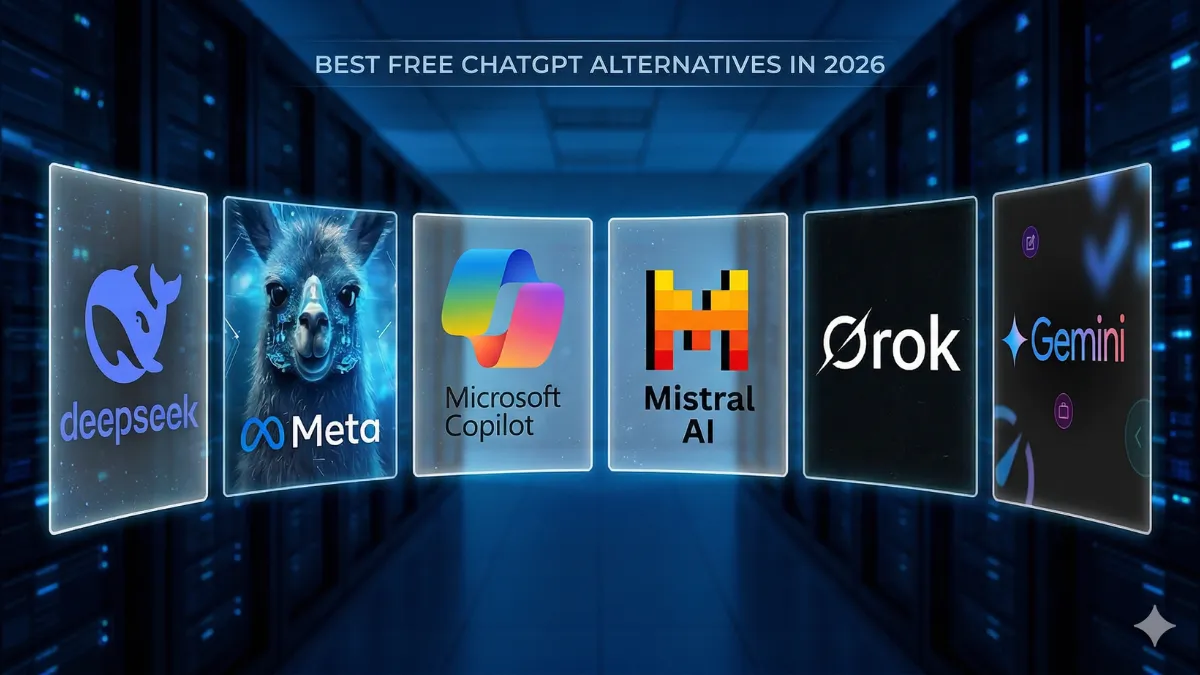
4. Microsoft Copilot — Best Free Tier for Microsoft 365 Users
Microsoft Copilot’s free tier is powered by OpenAI’s models with Bing’s real-time web search integrated at no cost — meaning free users get live web access that ChatGPT’s free tier does not provide by default. The value proposition is straightforward: if most of your work happens in Word, Excel, PowerPoint, Outlook, or Microsoft Teams, Copilot’s ambient integration reduces context-switching in ways that a standalone chatbot cannot replicate.
The paid tier (Microsoft 365, from $9.99/month) deepens this integration significantly — Copilot can draft emails in your writing style directly in Outlook, generate Excel formulas from natural language, and create PowerPoint decks from uploaded documents. The free tier offers a capable generalist chatbot with better-than-average web search accuracy.
For users outside the Microsoft ecosystem, Copilot’s value diminishes sharply. Its reasoning benchmarks trail Claude and GPT-5.4 on most complex tasks, and the free tier’s context window is narrower than Gemini or Claude.
Key limitation: Value is highly ecosystem-dependent. Standalone use against Claude or Gemini rarely favors Copilot.
5. DeepSeek — Best Free Tier for Developers and Technical Users
DeepSeek is the most disruptive free option in the 2026 AI landscape from a pricing standpoint. The full DeepThink reasoning mode — comparable to OpenAI’s reasoning-focused models — is available on the free web interface with no artificial usage caps. For developers who primarily need code generation, debugging, and technical problem-solving, DeepSeek delivers near-frontier capability at zero cost.
DeepSeek V3 uses a Mixture-of-Experts architecture with 671 billion total parameters, activating 37 billion per token. It is fully open-source under the MIT license. The API pricing starts at $0.028 per million tokens for cache hits — roughly 50 to 100 times cheaper than comparable OpenAI tiers. Three AI startups publicly documented cutting their compute costs by over 40% after migrating from GPT-5.2 to DeepSeek’s API.
The significant caveat is data sovereignty. Multiple Western governments have restricted or banned DeepSeek on organizational devices due to Chinese national security law provisions that can require companies to provide data to authorities. For individual users and non-sensitive personal projects, this risk profile is manageable. For any organization handling EU citizen data, U.S. federal contractor information, or HIPAA-regulated records, the hosted service presents genuine data sovereignty risk that cannot be resolved without self-hosting.
The interface is also functional rather than polished. No image generation, no voice mode, no multimodal input. For users who prioritize reasoning quality and cost over UX, this is acceptable. For general consumers, it is a meaningful friction point.
Key limitation: Serious data privacy concerns for organizational use. Minimal UI polish compared to Gemini, Claude, or ChatGPT.
6. Meta AI — Best Free Tier for Social Media Integration
Meta AI is embedded directly inside WhatsApp, Instagram, Facebook, and Messenger — platforms where billions of users already spend significant time. The practical advantage is zero context-switching: ask Meta AI a question about something mentioned in a Facebook post without leaving the app. This frictionless access pattern is genuinely differentiated, and for casual users, it may matter more than technical capability differences.
Meta AI’s underlying model is Llama-based and free with no usage caps. The general reasoning quality and creative output lag behind Claude and GPT-5.4 on most benchmark tasks. It does not have the source-citation system of Perplexity, the deep integration depth of Gemini, or the instruction-following precision of Claude. But for quick question-answering, travel suggestions, and light conversational tasks — delivered inside the social apps users already use — Meta AI provides a genuinely low-friction free experience.
Key limitation: Weaker general reasoning than Claude, Gemini, or ChatGPT. Not suitable for professional writing, complex code generation, or deep research workflows.
Free ChatGPT Alternatives Comparison Table 2026
| Tool | Free Model | Context Window (Free) | Real-Time Web | Best For | Key Limitation |
|---|---|---|---|---|---|
| Google Gemini | Gemini 2.5 Flash | 32K tokens | Yes (Google Search) | Multimodal tasks, Google Workspace | 32K cap for long docs |
| Claude | Sonnet 4.6 | 200K tokens | No (standard) | Long docs, writing, reasoning | Daily rate limits |
| Perplexity AI | Sonar | Unlimited basic | Yes (RAG-native) | Research, fact-checking, citations | 5 Pro searches/day free |
| Microsoft Copilot | GPT (via Bing) | Moderate | Yes (Bing) | Microsoft 365 users | Weak outside MS ecosystem |
| DeepSeek | DeepSeek V3 | Large | Limited | Coding, technical tasks, API use | Data sovereignty concerns |
| Meta AI | Llama-based | Standard | Limited | Quick social media Q&A | Weak reasoning vs peers |
How to Build a Free AI Stack in 2026
The most effective approach for power users is not picking one tool — it is assigning tasks to specialized tools:
- Research and fact-checking: Perplexity AI (verified citations, live sources)
- Long-document analysis and writing: Claude free tier (200K context, instruction fidelity)
- Google Workspace tasks and multimodal inputs: Gemini free tier
- High-volume API development: DeepSeek (open-source, near-zero cost)
- Social media and quick casual queries: Meta AI (embedded, friction-free)
- Microsoft 365 workflows: Copilot (native integration advantage)
This stack costs nothing. Each tool covers a gap the others leave. Most sophisticated AI users in 2026 operate exactly this way — not because any single tool fails, but because different architectures produce meaningfully different results for different task types.
Conclusion
The $20/month subscription to any AI chatbot is increasingly hard to justify as a primary tool when the free tiers of Claude, Gemini, and Perplexity cover the majority of professional use cases. Claude’s 200K token context window at zero cost, Gemini’s native Google integrations now available to free users, and Perplexity’s source-citation architecture make the value gap between free and paid tiers narrower than at any point in the industry’s history.
The next six to twelve months will accelerate this further. DeepSeek’s open-source pricing pressure is expected to force another 30–50% cost reduction across frontier models before end of 2026. Context windows approaching 10 million tokens will make the current 32K–200K range look restrictive. The organizations and individuals who ignore this shift and continue defaulting to ChatGPT Plus without evaluating alternatives are paying a premium that the market no longer requires. For most professional workflows, the right free stack already exists. The only cost is the fifteen minutes required to test it.
FAQ — People Also Ask
Q: What is the best completely free ChatGPT alternative in 2026? A: Claude and Google Gemini offer the strongest free tiers. Claude provides a 200K token context window and superior writing quality. Gemini includes image generation, voice chat, and Google Workspace integration — all free.
Q: Is DeepSeek a good free alternative to ChatGPT for developers? A: Yes, for individual and technical use. DeepSeek’s full reasoning mode is free with no usage caps, and its API pricing starts at $0.028 per million tokens. Organizational users should evaluate data sovereignty risks before adopting the hosted service.
Q: Does Perplexity AI have a free plan that’s actually useful? A: Yes. Unlimited basic searches are free with source citations included. Five Pro searches per day using advanced models are also included. Researchers who need more than five deep research queries daily should consider the $20/month Pro plan.
Q: Which free AI tool is best for long document analysis? A: Claude’s free tier, running on Sonnet 4.6 with a 200K token context window, handles long documents better than any competing free offering. It can process approximately 500 pages in a single session.
Q: Is Grok worth using as a free ChatGPT alternative? A: Grok’s free tier through X provides basic capabilities, but the paid SuperGrok plan at $30/month is expensive for what it delivers. Grok’s real-time X data access is its only genuine differentiator; for most tasks, Claude, Gemini, or Perplexity outperform it at lower or zero cost.